The short version
Crawl spaces, not basements, are the usual foundation under North Carolina houses, and a vented crawl space breathes humid summer air. A 2002 Advanced Energy study found closed crawl spaces stayed under 60 percent relative humidity all summer while vented ones tracked the outdoors. Damp framing, leaks and termites are the usual reasons a floor goes soft.
Why do so many Greensboro houses sit over a crawl space?
In much of the country a remodeler worries about the basement. Here the space under the house is usually a crawl space. Several North Carolina sources say the same thing: a Dry Pro Systems resource explains why the state has more crawl spaces than basements, and a Clayton real estate blog asks outright why basement homes are not common in North Carolina. In the Triad, Basement Systems runs a Greensboro crawl space repair page and AdvantaClean publishes encapsulation posts for Greensboro and High Point, which shows how much work goes on under these floors.
Crawl spaces are not the national default for new homes. An NAHB post puts 2024 new single-family foundations at about 73 percent slab, 17 percent basement and 9.2 percent crawl space. The Piedmont's existing housing tells a different story, and Greensboro has plenty of it: Point2Homes' reading of Census estimates puts the median home's build year around 1985.
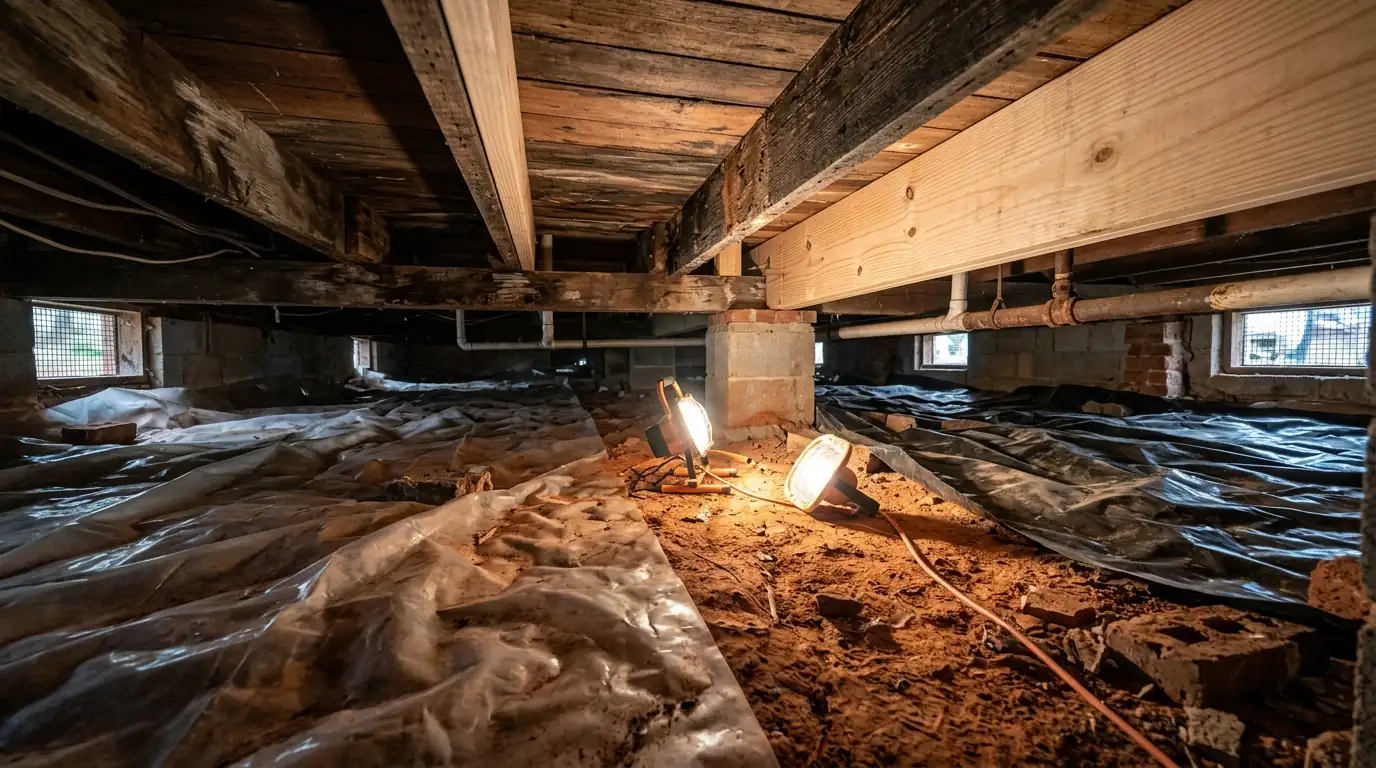
A crawl space puts the floor framing just above bare soil, in air that is often as humid as the outdoors. That arrangement works for decades when it stays dry. When it does not, the floor tells you.
What makes a floor feel soft, springy or sloped?
Soft floors come from three places, and the repair depends on which one you have. Before anyone quotes a fix, it helps to know which of these you are dealing with.
A floor that slopes toward one spot, a toilet that rocks even after the bolts are snugged, a dishwasher that drops at the front, or a tile that cracks again after being replaced are all signs worth a look from below. So is a musty smell coming up through the floor registers.
- The subfloor has failed. The plywood or board sheathing under the finish floor has been wet long enough to delaminate or rot. This is usually local: around a toilet, in front of a tub, under a dishwasher or at the sink base.
- The joists have weakened. Moisture, rot or insect damage has reduced the framing itself, so a wider area flexes or sags. Bounce that you feel across a whole room usually points here.
- The framing was cut or undersized. Over the years, plumbing or duct work may have notched or cut joists to pass a pipe. The wood is sound, but it carries less than it was built to.
How crawl-space humidity works on floor framing
Greensboro's climate is humid subtropical. Under 1991-2020 normals at Piedmont Triad International Airport, the city averages about 44 inches of precipitation a year and a July high of 88.5 degrees. In a vented crawl space, that summer air moves in through the vents and meets cooler framing and ductwork underneath the house. Uninsulated or poorly sealed ducts can sweat in that air, dripping onto the framing below the registers through the summer.
A 2002 field study by Advanced Energy, summarized by Energy Vanguard, compared 12 North Carolina houses. The encapsulated, closed crawl spaces stayed below 60 percent relative humidity all summer. The vented ones tracked the humid outdoor air. That difference explains a lot of soft floors that are not caused by a plumbing leak: wood that sits in damp air for years absorbs moisture, loses strength and becomes food for rot and insects.
The soil adds to it. The Cecil series, North Carolina's official state soil, covers about 1.6 million acres of the Piedmont. It is high in kaolinite clay that drains slowly, so a yard that sends water toward the foundation keeps the ground under the house damp long after a storm. Gutters, downspouts and grading are part of a floor repair more often than people expect.
Call (336) 347-1995Questions about your own house? Call any hour and talk it through.
Why termites have to be ruled out before any floor repair
NC State Extension describes eastern subterranean termites as so common in North Carolina that homeowners are almost certain to run into them. They thrive on leaks, wood touching soil and damp, poorly ventilated crawl spaces, which is exactly the setting under many soft floors. Extension also warns that renovation which disturbs the treated soil band at the foundation can weaken termite protection.
Swarm season is the other clue. North Carolina's native subterranean termites swarm from late winter into the fall, often on a warm day after rain, and finding swarmers or their shed wings indoors usually means an active colony in or under the house. If you see that, call a pest control company before you call us. New joists fastened to infested wood are wasted money.
When we open a floor and find termite damage, we stop, show you, and recommend treatment before the repair goes back together. Doing it the other way round just hides the problem under fresh plywood.
What do subfloor and joist repairs cost?
There is no Greensboro-specific price for floor framing repair in the sources we rely on, so the national figures below are the honest starting point. Angi puts subfloor replacement at $3 to $10 per square foot, or $900 to $3,000 for a 300 square foot room. Its dry rot guide prices floor structure repair at $15 to $40 per square foot, and professional dry rot repair overall at $500 to $3,000.
The spread between the subfloor and structure numbers is the point. Replacing a soft patch of sheathing is carpentry. Sistering or replacing joists means working from the crawl space, often on your back, and sometimes jacking the floor back toward level before new wood goes in. Fixr's Greensboro bath guide carries an allowance of about $2,928 for hidden water damage found mid-remodel, which is a fair picture of what a soft spot by a tub can turn into.
| Repair | Published range | Source |
|---|---|---|
| Subfloor replacement | $3 to $10 per sq ft; $900 to $3,000 for a 300 sq ft room | Angi |
| Floor structure rot repair | $15 to $40 per sq ft | Angi |
| Professional dry rot repair | $500 to $3,000 | Angi |
| Hidden water damage found in a Greensboro bath remodel | about $2,928 | Fixr Greensboro |
How we repair a soft floor from above and below
We start underneath. A look at the crawl space with a light and a probe tells us whether the problem is the sheathing, the joists or both, and whether moisture or insects are still at work. Then we decide whether to repair from above, from below or both, and the sequence looks like this.
Our subfloor repair and wood rot repair work covers the structure, and the finish floor follows, whether that is luxury vinyl plank, tile or a hardwood patch. If the soft spot is in a bathroom, the Greensboro bathroom cost guide explains how that repair fits into a larger remodel, and our hardwood versus LVP guide covers which floor suits a room over a crawl space.
- Find and stop the water source first: a wax ring, a supply line, a shower pan, a dishwasher hose or a downspout dumping at the foundation.
- Probe and mark how far the damage runs in the joists and the sill.
- Sister new lumber alongside weakened joists, or replace sections, with the floor supported while we work.
- Cut out soft subfloor back to sound wood and glue and screw new panels to the framing.
- Restore the finish floor, and check the area again from below once it is closed up.
When a soft floor needs attention right away
A soft spot that keeps growing, a toilet that rocks, water stains on the joists below a bathroom, or a floor that has dropped in front of a tub should not wait for a remodel. Every week of an active leak feeds the rot and makes the repair bigger. If water is still moving, shut the supply valve to that fixture first, keep heavy loads such as a filled tub off the area, and call any hour.
Other signs can wait for a planned repair: a floor that has felt the same for years, a gentle slope in an older house with no cracking, or a single squeaky board. Those are worth a look when it suits you, and the fix often folds neatly into a flooring or bath project you were planning anyway.
Sources
- Why North Carolina Has More Crawl Spaces Than Basements - Dry Pro Systems
- Why Are Basement Homes Not Common In North Carolina - Clayton NC real estate blog
- Greensboro Crawl Space Repair - Basement Systems
- Crawl space encapsulation - AdvantaClean of Greensboro
- NAHB post on 2024 new single-family foundation types
- Greensboro, NC demographics - Point2Homes (citing ACS 2019-2023 5-year estimates)
- Greensboro, North Carolina - Wikipedia (Climate section, NOAA normals)
- Crawl Space Building Science - Energy Vanguard
- North Carolina State Soil: Cecil - Soils4Teachers (SSSA)
- Monitoring and Management of Eastern Subterranean Termites - NC State Extension (Jan 22, 2025)
- Termite Swarmers - What Do They Mean for You? - NC State Extension
- How Much Does Subfloor Replacement Cost? - Angi
- How Much Does Dry Rot Repair Cost? - Angi
- Fixr - Greensboro NC bathroom remodel cost guide (Dan Simms)