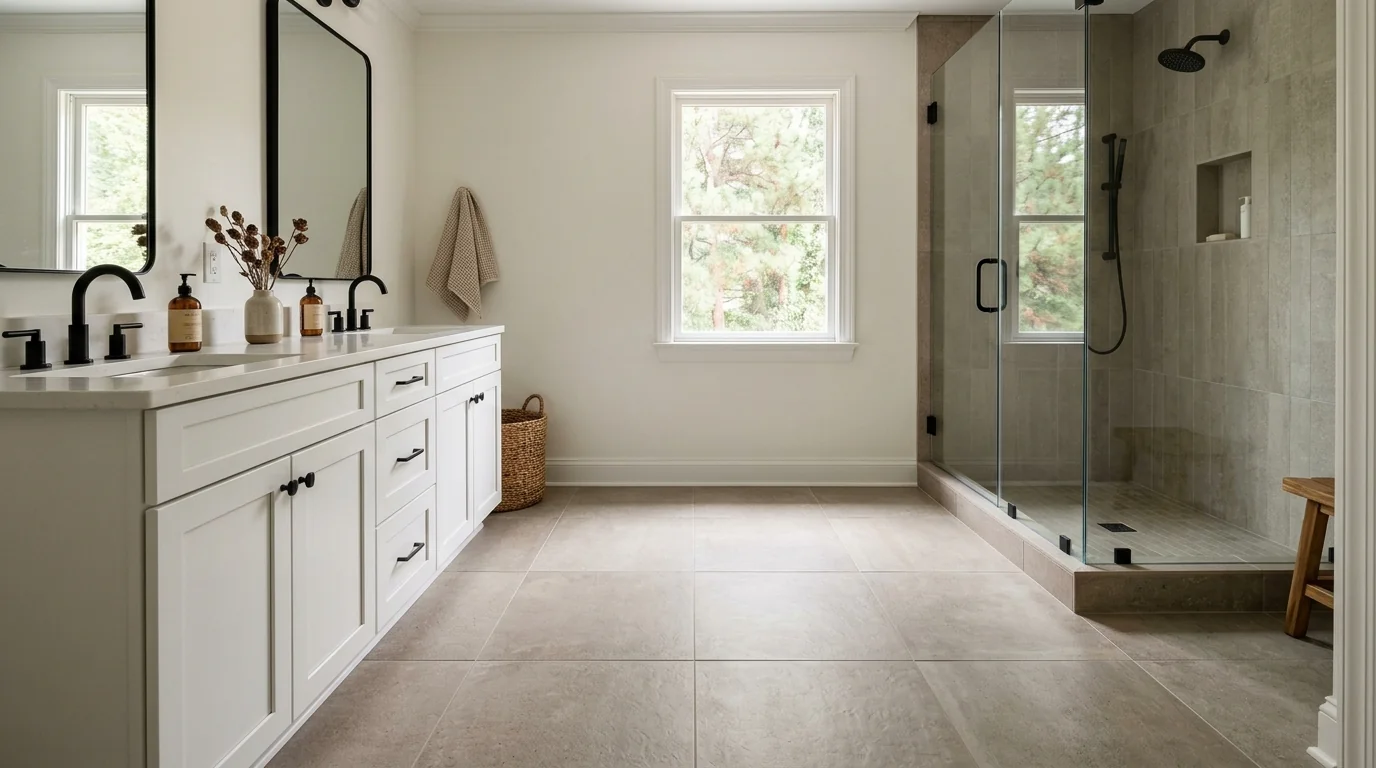
Short answer
Greensboro tile floors run $10 to $20 per square foot for ceramic or porcelain in Fixr's local bathroom guide, and $20 to $50 for natural stone. The framing under the tile decides how long it lasts: a wood floor that flexes cracks tile and grout, so we check stiffness first.
Tile is rigid, and wood framing is not. Over a crawl space or on a second floor, joists and subfloor have to be stiff enough for the tile you picked, and stone needs a stiffer floor than porcelain. We check that before quoting, then add subfloor, cement backer board or an uncoupling membrane as the floor requires.
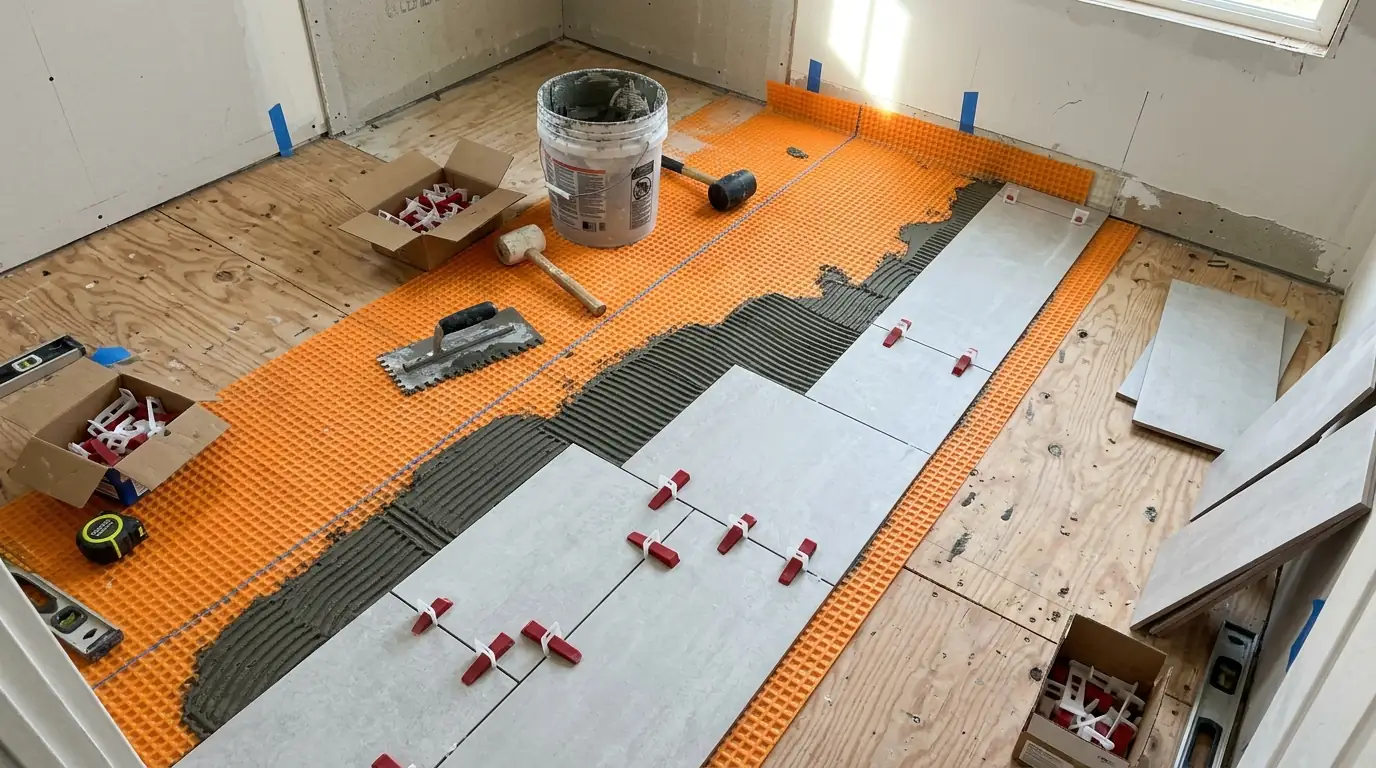
The rest is layout and mortar. We find the room's center lines and plan cuts so thin slivers land under the vanity or in a closet, not at the doorway. Each tile is set in full mortar coverage, which matters most with large tiles, then grouted, with a movement gap left at the walls.
What moves the price of tile floor installation
Tile is priced per square foot, and the base under it can cost as much as setting the tile.
- Tile type Ceramic, porcelain and stone each have their own installed range.
- Size and pattern Large format and diagonal or herringbone layouts add prep and cuts.
- Floor prep Tear-out, plywood, membranes or self-leveler add labor.
- Room shape Small baths with many cuts cost more per square foot.
| What the figure covers | Published range | Source |
|---|---|---|
| Bathroom tile flooring, Greensboro | Ceramic/porcelain tile $10 to $20 per sq ft; natural stone $20 to $50 per sq ft | Fixr - Greensboro NC bathroom remodel cost guide (Dan Simms) |
Published figures are averages from the sources named, not a quote. Your price comes after the walk-through.
Porcelain, ceramic or natural stone
| Tile | Water resistance | Floor it needs |
|---|---|---|
| Porcelain | Very low absorption | Standard stiffness |
| Ceramic | Higher absorption | Standard stiffness, lighter traffic |
| Natural stone | Needs sealing | Stiffer floor, sometimes extra plywood |
Porcelain and ceramic floor tile
Porcelain is denser and absorbs less water than ceramic, so it is the usual pick for baths, kitchens and entries. Ceramic is softer, cheaper and fine for light-traffic rooms such as a guest bath. Both are set in thinset over a backer or membrane, never straight onto plank subfloor. Fixr's Greensboro bathroom guide lists ceramic and porcelain tile flooring at $10 to $20 per square foot, while HomeGuide's national installed ranges run $12 to $40 for ceramic and $15 to $50 for porcelain.
Large-format tile and keeping it flat
Tiles of 24 inches and longer look clean with few grout lines, but they demand a very flat floor. A small hump in the subfloor turns into lippage, where one tile edge sits higher than the next and catches a toe. We flatten the floor with self-leveling compound when needed, use a mortar made for large tiles, back-butter each piece and set it with a leveling clip system. Long tiles also show any bow in the tile itself, so we choose the joint offset to suit.
Natural stone floors
Marble, travertine and slate are softer and more variable than porcelain, and they crack if the floor beneath them flexes. Stone needs a stiffer structure, sometimes an added layer of plywood over the subfloor, and it needs sealing. We sort the boxes for color and veining before setting, so the floor does not end up with a patch of odd tiles in the middle of the room. Fixr's Greensboro bathroom guide puts natural stone flooring at $20 to $50 per square foot.
Uncoupling membranes and cement backer board
What goes under tile matters more than the tile. Cement backer board, set in thinset and screwed to the subfloor, gives tile a stable base that tolerates water. An uncoupling membrane goes further, letting the wood floor move slightly without passing that stress up into the tile, which cuts down on cracked tiles and grout. In a bathroom we often add a waterproofing membrane too. Neither one replaces a stiff floor; they work on top of one. When we tear out a cracked floor, the missing layer is usually the cause.
Call (336) 347-1995Want someone to look at your room? The phone is answered around the clock.
Remodeling this in Greensboro houses
Greensboro has plenty of houses old enough to need floor work before tile. ACS figures compiled by Point2Homes put about 42.7 percent of the city's housing before 1980 and roughly 9.8 percent before 1950. A bath or kitchen floor in a house that age may carry two or three earlier floors, and the framing around the toilet and tub may have seen old leaks. We open the floor rather than tile over a problem, because tile set over a soft spot cracks along it.
Signs it is time to call
- Cracks running across tilesA line through several tiles usually follows a joist or seam that moves.
- Hollow sound underfootTile that sounds hollow has lost its bond.
- Crumbling groutGrout breaking out points to movement or water below.
- Soft spot by the toilet or tubA spongy wet-area floor often means rot beneath.
How we run the job, step by step
- Check stiffnessJoists and subfloor checked from below where we can.
- Tear outOld tile, vinyl and damaged subfloor come out.
- Build the basePlywood, backer board or membrane to suit the tile.
- Lay outCenter lines and cut placement set before mixing.
- Set and groutFull-coverage mortar, then grout and cleanup.
- Seal and trimGrout or stone sealed; base and thresholds back on.