The short version
Fixr's Greensboro remodel guide puts installed hardwood at $7 to $25 per square foot and luxury vinyl plank at $4 to $16. LVP shrugs off water on its surface; solid hardwood can be sanded and refinished, which HomeAdvisor prices at $3 to $8 per square foot. Over a damp crawl space, the subfloor matters more than the plank.
How do hardwood and LVP compare on cost in Greensboro?
Fixr's Greensboro remodel guides give installed ranges for both. Hardwood runs $7 to $25 per square foot on its kitchen page, and luxury vinyl plank runs $4 to $16, with the bathroom page listing $4 to $15. The ranges overlap, which is the first useful thing to know: a high-end LVP can cost as much as a basic hardwood install.
Labor is a big share of either. Fixr's national LVP guide puts installation labor at $1.50 to $6 per square foot. Site-finished hardwood adds sanding and several coats of finish after the boards are down, which is part of why its range runs higher, and prefinished or engineered boards narrow that gap.
| Floor | Installed cost | Source |
|---|---|---|
| Hardwood, Greensboro | $7 to $25 per sq ft | Fixr Greensboro kitchen guide |
| LVP, Greensboro | $4 to $16 per sq ft ($4 to $15 on the bath page) | Fixr Greensboro guides |
| Solid hardwood, national | $5 to $28 per sq ft | HomeAdvisor |
| Engineered hardwood, national | $4.50 to $16 per sq ft | HomeAdvisor |
| Hardwood project, national | $2,469 to $7,034; average $4,723 | HomeAdvisor |
| LVP, national | $3 to $16 per sq ft; most pay $5 to $12 | Fixr |
What crawl-space humidity does to wood floors
Crawl spaces, not basements, are the norm under North Carolina houses, and that matters more for hardwood than for almost anything else in the house. Wood takes on and gives up moisture with the air around it, swelling in damp months and shrinking in dry ones. A floor over a crawl space feels both the room above and the air below.
A 2002 Advanced Energy field study of 12 North Carolina houses found that encapsulated, closed crawl spaces stayed below 60 percent relative humidity all summer, while vented crawl spaces tracked the humid outdoor air. Under a hardwood floor, that humid air is what makes boards cup, with their edges standing higher than their centers. Gaps that open every winter and close every summer are the other half of the same cycle.
None of this rules out hardwood over a crawl space. It means checking the crawl space first, letting the wood acclimate in the house before installation, and fixing a wet crawl space before laying new boards over it. LVP is far less sensitive to humidity, which makes it the forgiving choice where the crawl space has a history.
Kitchens, baths and laundry rooms: where LVP earns its place
On its surface, luxury vinyl plank does not mind water. A spilled pot, a wet dog or a dripping dishwasher wipes up without damage, which makes it a strong choice for kitchens, baths, mudrooms and laundry rooms. Hardwood in those rooms needs prompt cleanup and a finish kept in good repair.
The catch is what happens under the plank. Water that gets through the seams or comes from below, such as a slow leak at a supply line, can sit on the subfloor unseen. LVP will not show damage the way swollen hardwood does, so a leak can go on longer. NC State Extension notes that termites thrive on leaks and damp crawl spaces, so a hidden wet subfloor is more than a flooring problem. Luxury vinyl plank is a good fit for wet rooms; we just make sure the subfloor under it is sound and dry first.
Refinishing: why hardwood is the long-term choice
The strongest argument for solid hardwood is that it can be renewed. HomeAdvisor puts sanding and refinishing at $3 to $8 per square foot, with typical projects at $1,107 to $2,681 and an average of $1,892. A worn floor can be sanded to fresh wood, restained a new color and given a new finish, and a floor in good shape can simply be screened and recoated.
LVP cannot be refinished. Its look comes from a printed layer under a wear layer, and once the wear layer is scratched through, the plank has to be replaced. Good LVP lasts a long time in normal use, but a household with large dogs, rolling chairs or a lot of grit tracked in will see the difference over the years.
Before choosing either, look under the carpet. Preservation Greensboro's history of Westerwood describes the typical 1920s interiors there as having hardwood floors, and older houses elsewhere in the city may have oak hiding under carpet or vinyl too. Refinishing what is already there usually costs less per square foot than installing anything new.
Call (336) 347-1995Questions about your own house? Call any hour and talk it through.
Blending new floors with an existing hardwood house
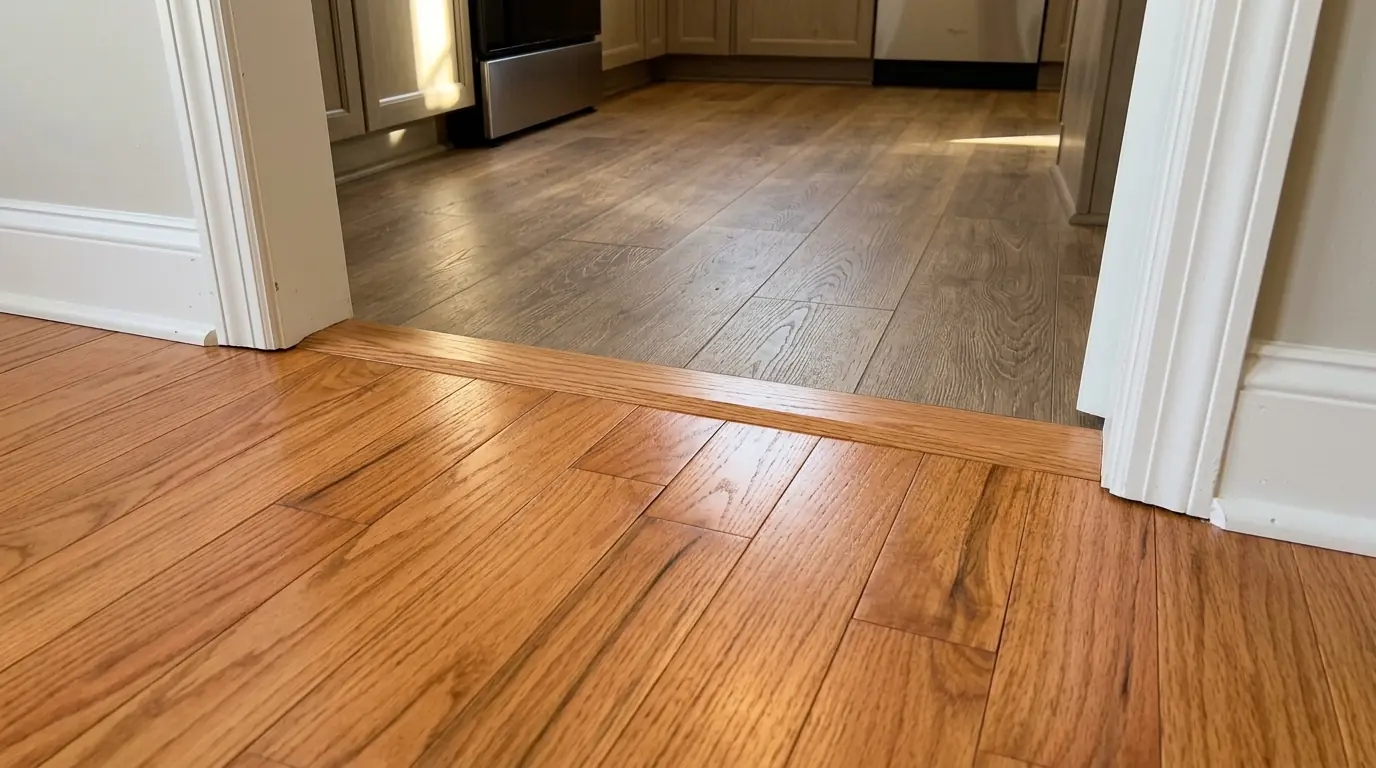
Many remodels are partial. A kitchen opens to a hall with original oak, or a bathroom addition meets a bedroom with site-finished floors. Weaving new boards into old ones, by removing short lengths and toothing in new ones so the joints stagger, then sanding and finishing the whole area together, gives a floor that reads as one. Changing to LVP at a doorway is simpler and cheaper, but the transition shows.
With about 42.7 percent of Greensboro homes built before 1980, according to Point2Homes' reading of ACS data, the question comes up often. Our hardwood flooring installation work includes weaving into existing floors, and the decision usually turns on how visible the transition will be and how long you plan to stay in the house.
Species and board width matter more than color when you blend. Old red oak strip flooring takes stain differently from white oak or a wide plank, so the new boards should be the same species and width as the old ones, with the color worked out on sample boards once everything is sanded together.
Is engineered hardwood a middle option?
For many Greensboro houses it is. Engineered hardwood is a real wood surface layer glued to a plywood or composite core. HomeAdvisor's national figures put it at $4.50 to $16 per square foot installed, against $5 to $28 for solid hardwood, so it often lands closer to LVP pricing than people expect.
The layered core makes it more stable than solid boards when humidity swings, which helps over a crawl space, and some engineered floors can be glued down where solid hardwood would have to be nailed. The trade-off is the wear layer. A thick one can be sanded and refinished, though fewer times than solid wood; a thin one behaves more like a prefinished floor that can only be recoated.
If you want real wood in a room where the crawl space is not perfect, or over a floor where nailing is awkward, engineered hardwood deserves a look before you settle on either extreme.
Which floor goes where?
There is no single winner. This is how the two usually sort out room by room in a Greensboro house, assuming the subfloor is sound.
- Living room, dining room and bedrooms: hardwood, if the crawl space is dry and you want a floor that can be refinished.
- Kitchen: either. LVP forgives spills; hardwood ties the kitchen into an open plan with wood floors around it.
- Full baths and laundry rooms: LVP or tile, since water on the floor is routine there.
- Mudrooms and entries from the garage: LVP or tile, for grit and wet shoes.
- Rental units: LVP, for durability between tenants and low replacement cost.
- Rooms over a damp crawl space: fix the crawl space, then choose; if that has to wait, LVP is the safer bet.
Getting the subfloor right under either floor
Whichever floor you choose, it is only as good as what is under it. Both need a flat, solid subfloor. LVP telegraphs every dip and ridge in the floor below it, and click-lock planks can separate at the seams if the floor flexes. Hardwood nailed into soft or delaminated sheathing squeaks and moves.
That is why our flooring estimates start with a look at the subfloor and, where we can, the crawl space underneath. Soft spots get cut out and replaced, high spots get planed and low spots get filled before the first plank goes down. If you are weighing the two floors for a particular room, call any hour and we will check what is under it before recommending either.
Sources
- Fixr - Greensboro NC kitchen remodel cost guide (Dan Simms)
- Fixr - Greensboro NC bathroom remodel cost guide (Dan Simms)
- How Much Does Hardwood Floor Installation Cost? - HomeAdvisor
- How Much Does It Cost to Refinish Hardwood Floors? - HomeAdvisor
- Luxury Vinyl Plank Flooring Cost - Fixr (Adam Graham)
- Crawl Space Building Science - Energy Vanguard
- Why North Carolina Has More Crawl Spaces Than Basements - Dry Pro Systems
- Monitoring and Management of Eastern Subterranean Termites - NC State Extension (Jan 22, 2025)
- The Secrets of Westerwood - Preservation Greensboro
- Greensboro, NC demographics - Point2Homes (citing ACS 2019-2023 5-year estimates)