Short answer
Before any rebuild in a Greensboro home, the water has to be stopped and the structure dried. Right now: shut off the main or fixture valve, cut power to wet areas, photograph everything, and call your insurer and a water mitigation company to dry the house. We rebuild after they leave.
Signs it is time to call
- Paint bubblingBlisters near the floor can mean water is still in the drywall.
- Baseboard pulling awaySwollen base separating at the bottom has taken on water.
- Floor edges cuppingRaised board edges mean moisture underneath.
- A ceiling stain that growsA widening ring means an active leak; stop it first.
How we run the job, step by step
- Confirm it is dryFraming and subfloor get metered.
- Measure and photographEvery opened area is documented.
- Write the scopeLine items mirror the adjuster's.
- Order slow items firstCabinets and flooring are ordered early.
- Rebuild in sequenceDrywall and paint, then cabinets, floors and trim.
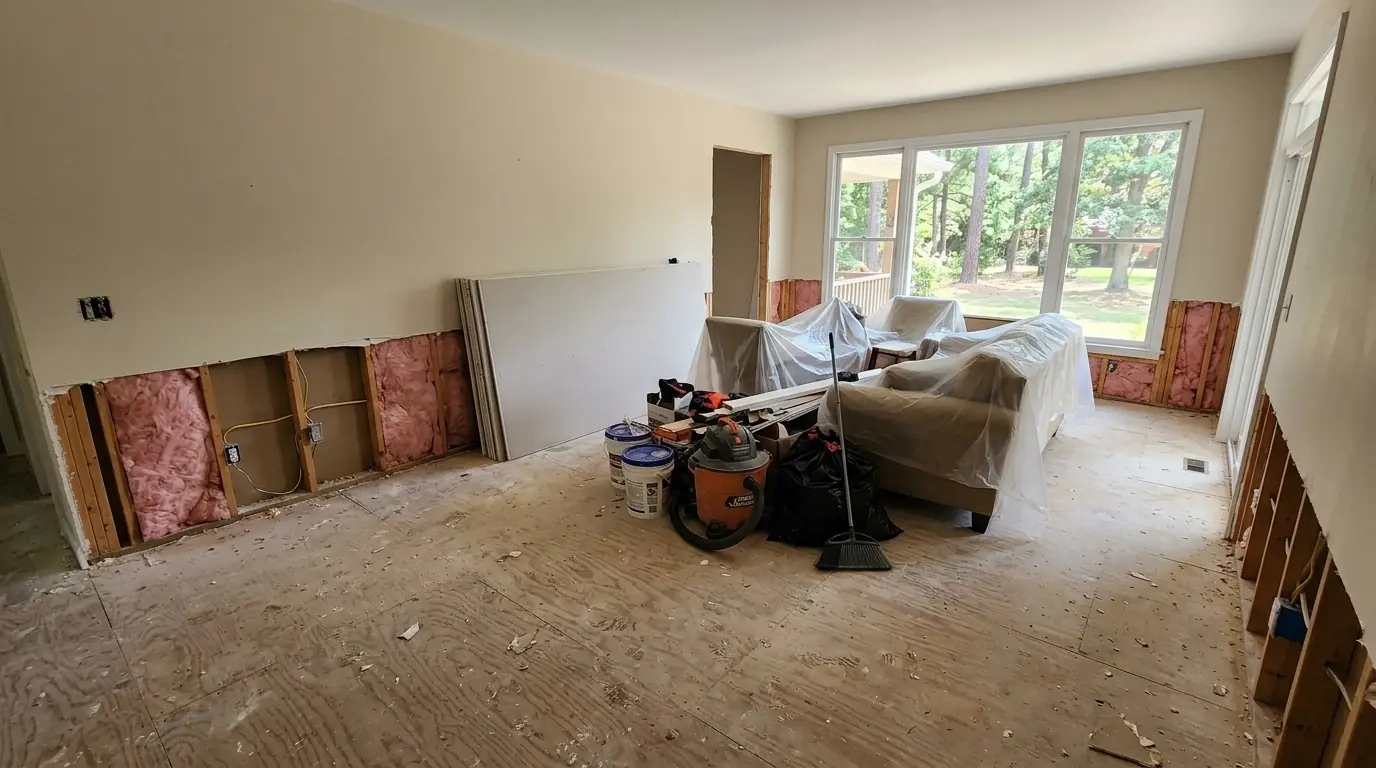
Our part of a water loss starts once the drying company has pulled its equipment and moisture readings are normal. By then, wet drywall has usually been cut out at a flood line, baseboards removed, and sometimes cabinets or flooring pulled. What is left is an opened-up room and a list to put back.
Rebuilding too early is the costliest mistake. Drywall hung over wet studs, or hardwood laid on a damp subfloor, can cup, stain or grow mold behind the new finish. We meter framing and subfloor moisture before anything closes, and we do not start until the readings are where they should be.
Putting back ceilings and walls that were cut open
After a supply line or upstairs bath leaks, the ceiling below often has a hole cut in it and the walls have a strip removed near the floor. We confirm the insulation was replaced or dried, hang new drywall, finish it to the surrounding texture, and prime and paint so the patch disappears. HomeGuide's national figures put drywall replacement in water damage work at $1.50 to $3.50 per square foot, and HomeAdvisor lists replacing a whole wall of drywall at $500 to $1,600.
Floors that cupped, buckled or lifted after a leak
Hardwood that cups, laminate that peaks at the seams and vinyl plank that lifts all mean water got under the floor. Some hardwood flattens as it dries and can be refinished, while swollen laminate and most click-lock vinyl cannot be saved. We check the subfloor first, since a floor laid over wet plywood fails again. Replacement boards are woven into the existing field so the repair does not read as a patch. HomeGuide puts hardwood flooring replacement at $7 to $25 per square foot.
Base cabinets that swelled after a dishwasher or sink leak
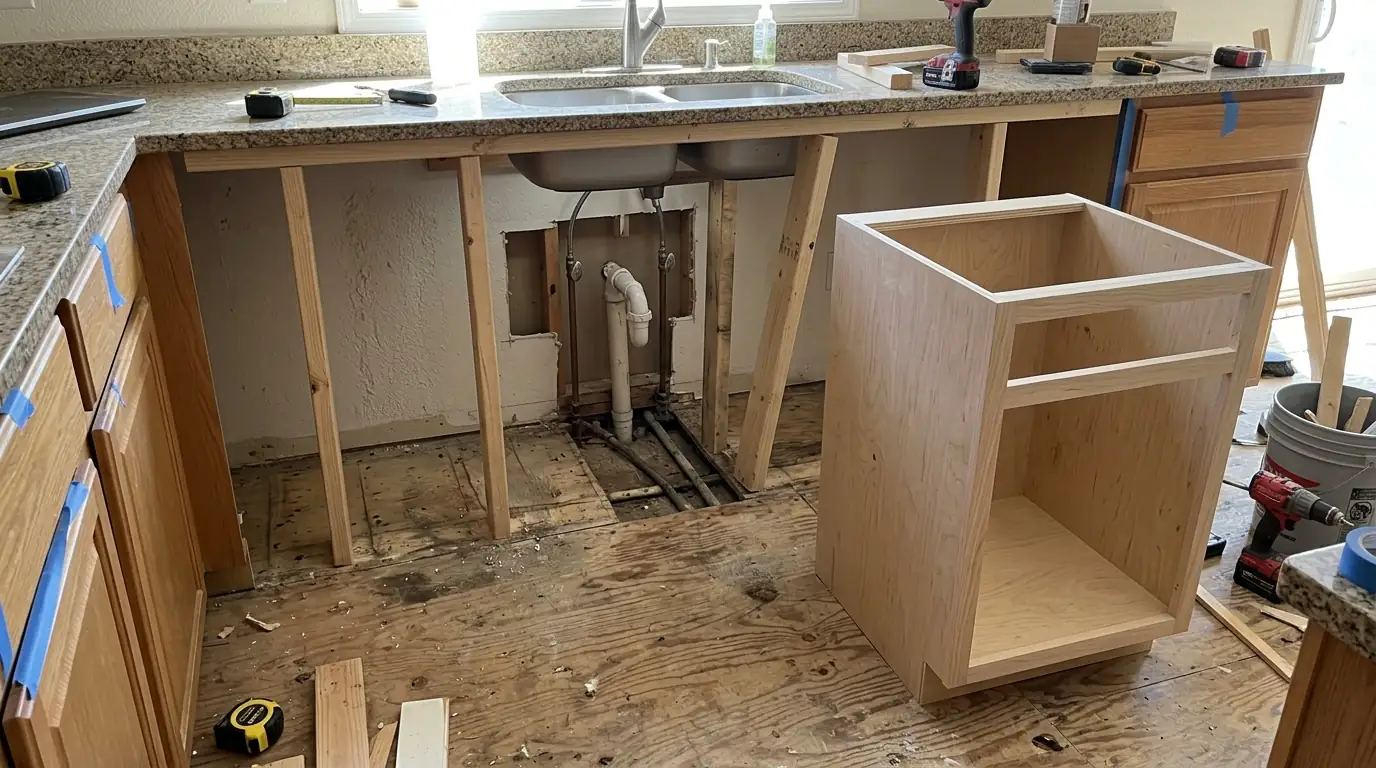
Particleboard cabinet boxes swell and crumble once wet, starting under the sink or beside the dishwasher. Misaligned doors or a soft toe kick give it away. If the line is still made, we replace only the damaged boxes, supporting the countertop meanwhile. If it is discontinued, the choice is a box built to fit the old doors or a new run, and we explain what each means for the countertop. Fixr's Greensboro guide puts new cabinets at about $7,360 on average.
Walking the damage with your insurance adjuster
Most water losses go through a homeowner's policy, and the adjuster's estimate is built line by line: square feet of drywall, linear feet of base, each cabinet box. We meet the adjuster at the house when you want us there, measure and photograph, and write our rebuild scope in the same terms so the two compare item by item. Damage found once a wall is open gets documented before we go further, which supports a supplement request. Coverage decisions stay between you and your insurer.
Remodeling this in Greensboro houses
Water does not only come from pipes. Greensboro has a long tornado history, from the F4 of April 2, 1936, which cut a seven-mile path through the south side, to the EF2 of April 15, 2018, which destroyed at least 20 homes and businesses around East Bessemer Avenue and Sunnycrest. Torn roofs let rain in. Below the floor, a 2002 Advanced Energy study found vented North Carolina crawl spaces tracking humid summer air, so we meter subfloors before rebuilding.
What our rebuild covers, and what the drying company handles
- Moisture readings before anything closes
- Insulation and drywall finished to the existing texture
- Primer and paint on repaired surfaces
- Baseboard, casing and cabinet replacement
- Flooring and subfloor repair
- Not ours: extraction, drying and mold remediation, which the mitigation company handles first
What moves the price of water damage repair
HomeGuide's national totals include extraction and drying, which the mitigation company handles. The per-square-foot rebuild items are closer to our part.
- What was removed More cut out means more to put back.
- Clean or dirty water A supply line leak and a sewage backup end differently.
- Finish continuity Flooring that runs through rooms widens the repair.
- Hidden damage Wet framing found once walls are open adds scope.
| What the figure covers | Published range | Source |
|---|---|---|
| Average restoration, national, drying included | $2,000 to $6,000 | How Much Does Water Damage Restoration Cost? - HomeGuide |
| Drywall replacement in water damage work | $1.50 to $3.50 per sq ft | How Much Does Water Damage Restoration Cost? - HomeGuide |
| Hardwood flooring replacement | $7 to $25 per sq ft | How Much Does Water Damage Restoration Cost? - HomeGuide |
Published figures are averages from the sources named, not a quote. Your price comes after the walk-through.