The short version
Exterior work anywhere on a lot in College Hill, Dunleath or Fisher Park needs a Certificate of Appropriateness (COA), Greensboro's written design approval for historic properties, before the city will issue a building permit, and there is currently no fee for it. Staff can approve minor items in about 3 to 4 days; additions go to the Historic Preservation Commission, which meets monthly.
Which Greensboro neighborhoods are local historic districts?
Greensboro has three local historic districts: College Hill, Dunleath and Fisher Park. Inside them, the city applies design review to exterior work. Outside them, even on streets lined with old houses, it does not, and that boundary is the first thing to settle before planning any exterior project.
College Hill was the first, designated in 1980. Fisher Park followed in 1982. It is a streetcar suburb with Prairie, Craftsman, Colonial Revival and Tudor houses, and it was listed on the National Register in 1992, with a boundary increase in 1996. Dunleath, known as the Charles B. Aycock Historic District until it was renamed in 2017, began when Summit Avenue was graded in 1895, and most of its houses are late 19th- and early 20th-century Queen Anne, Colonial Revival and Craftsman designs.
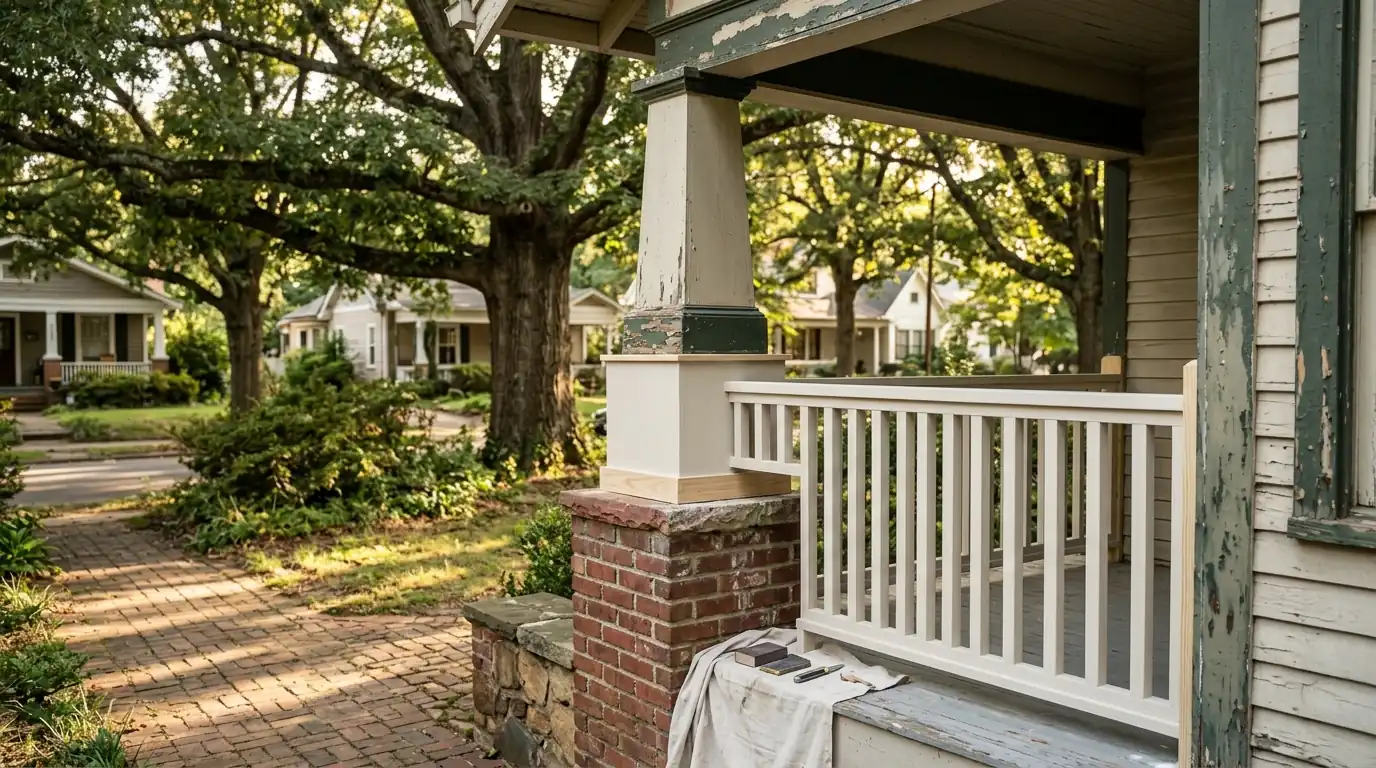
Those styles matter for a remodel. Queen Anne porches, Craftsman brackets and exposed rafter tails, and Tudor half-timbering are the details review is meant to protect. They are also the details most likely to be rotted, patched or missing after a century of Piedmont weather, so a large share of historic district work is careful repair rather than anything new.
Does National Register listing mean design review?
No, and the difference trips up buyers and sellers alike. Preservation Greensboro explains that only properties inside the local historic overlay get design review. Listing on the National Register does not, by itself, bring review in Greensboro, although it can make a property eligible for historic tax credits.
Fisher Park shows both at once. It is a local historic district, so exterior work there goes through review, and it is also on the National Register, which opens the tax credit question for qualifying work. A house that sits on the Register but outside the three local districts has no city design review for its exterior, though its tax credit eligibility may still be worth checking with a preservation professional before a large project.
What exterior work needs a COA, and who approves it?
In all three districts, exterior work needs a COA before it starts. The city's historic district FAQ is specific that this covers exterior work anywhere on the lot, including the back of the house where no one on the street will see it. No building permit is issued for that work until the COA is granted. There is currently no fee for a COA.
Review comes in two levels. Staff can approve minor work, which the city describes as items such as repairs, fences and back-yard decks, and front porch repairs and new decks are typically approved within 3 to 4 days. New construction, additions and major alterations go to the Historic Preservation Commission, which meets on the last Wednesday of each month, with applications due three weeks ahead.
| Exterior work | Who decides | Timing the city describes |
|---|---|---|
| Repairs and fences | City staff, as minor work | Handled at staff level |
| Front porch repairs and new decks, including back-yard decks | City staff, as minor work | Typically 3 to 4 days |
| Additions | Historic Preservation Commission, as major work | Last Wednesday of each month; applications due three weeks ahead |
| New construction and major alterations | Historic Preservation Commission | Same monthly cycle |
Why the guidelines favor repair over replacement
Greensboro's historic district guidelines prefer repairing original materials to replacing them. When siding or trim has rotted past saving, the guidelines call for replacement in kind, meaning wood for wood. Fiber-cement and PVC, the materials most people would reach for on a newer house, are not recommended.
College Hill's neighborhood association adds detail for its district. Window replacement there needs prior approval, and swapping wood siding or exterior doors for vinyl or aluminum is considered inappropriate. If the original windows are rough, the realistic path is usually repair: freeing painted-shut sash, reglazing, consolidating or splicing rotted sills, and repainting.
That suits the way we prefer to work on older houses anyway. In our historic home renovation and wood rot repair work, we cut out the rot, mill a replacement to the old profile and replace only what has failed. A siding board or a porch rail rebuilt that way looks right from the sidewalk, and it is the kind of work staff can approve without a commission hearing.
Call (336) 347-1995Questions about your own house? Call any hour and talk it through.
Porches, decks and additions in the three districts
Porches are where most of these houses show their age first. Floor boards, column bases and rail caps take the weather directly, and on Queen Anne and Craftsman houses the porch is also the most decorated part of the front. Because the city treats front porch repairs as minor work that staff can typically approve in 3 to 4 days, a porch rebuilt board for board in wood is one of the more straightforward historic district projects to get through.
New decks also sit at staff level, and the city names back-yard decks as minor work, which makes a deck behind the house a practical way to add outdoor space without a commission hearing. It still needs its approval before the permit, like everything else on the lot.
Additions are the opposite: major work, decided by the Historic Preservation Commission on its monthly cycle. Plan the design and the application together, and expect the commission's calendar, not the builder's, to set the earliest start date.
Can you remodel the inside of a historic district house freely?
For the most part, yes. The College Hill Neighborhood Association notes that interior renovation and exterior paint color do not need review in that district. And because the COA requirement is written around exterior work, a kitchen remodel or a new bathroom inside a Fisher Park or Dunleath house goes through the normal building and trade permits, the same as anywhere else in the city.
Watch the places where an interior project reaches outside. A new window opening for a kitchen layout, a bathroom exhaust vent through a side wall, a relocated back door or a new set of rear steps all count as exterior work on the lot, so each one needs a COA before the permit can issue. We look for those touchpoints when we draw up the plan, so the review is filed early instead of discovered late.
The same goes for anything on the roof or in the yard. A vent stack in a new spot, a fence, a shed or a back-yard deck can each be small jobs, but in these three districts each one is exterior work that needs its approval first.
How to plan a historic district project around the review calendar
The calendar is predictable once you know it. Staff-level items such as a porch repair or a new back deck are typically approved in 3 to 4 days. Anything that goes to the Historic Preservation Commission waits for its meeting on the last Wednesday of the month, with the application due three weeks before. An addition application that misses a deadline waits for the following month's meeting, and the building permit waits behind it.
In practice, that means the design work for a major project should be finished well before the date you want to start building. Here is the order we follow.
- Confirm whether the house is inside College Hill, Dunleath or Fisher Park, or only on the National Register.
- List every exterior change, including the back of the house, the roof, fences and outbuildings.
- Photograph existing conditions and note which materials are original.
- Plan repairs in kind first, with wood-for-wood replacement where repair is not possible.
- File for the COA, and for major work, count back three weeks from the commission's monthly meeting.
- Apply for the building permit once the COA is granted, then schedule the work.
Getting help with a house in one of the three districts
If you are unsure where your property falls, or how a piece of exterior work will be classed, call any hour. We can walk the house with you, list each exterior item and tell you which level of review it is likely to need. For the permit side of the job, see our Greensboro remodeling permits guide, and for what tends to hide inside houses of this age, the older-house checklist.
Sources
- Greensboro Historic District Program - City of Greensboro
- City Historic Districts FAQ - Greensboro Planning
- About Buying Property in the College Hill Historic District - College Hill Neighborhood Association
- Fisher Park, Greensboro, North Carolina - Wikipedia
- Dunleath Historical District - Wikipedia
- Location Matters in Historic District Preservation - Preservation Greensboro